Showing posts with label wartime. Show all posts

Sunday, 5 May 2013

Rations


Hullo! It has been a rather relaxing week - despite the revision and the essay deadlines - and I decided to give rationing a go. I spent a lot of time going hungry, which was not as bad as I thought it would be, and thoroughly enjoyed cooking for the week. This is the weekly ration for one adult per week.
Bacon & Ham: 4 oz
Meat: to the value of 1s6d (generally about 8-10oz, but as war went on the actual amount fluctuated)
Butter: 2 oz
Cheese: 2 oz
Margarine: 4 oz
Lard: 4 oz
Milk: 2-3 pints
Sugar: 8 oz
Preserves: 1 lb every 2 months
Tea: 2 oz
Eggs: 1 fresh egg per week (usually...)
Sweets: 12 oz every 4 weeks (if you were lucky)
These rations were subject to much change as the war went on. Offal - things such as kidney and liver - were not generally part of the meat ration and was often sold quite cheaply. Preserves could be bought, or exchanged for an extra sugar ration to make your own. The egg ration could be exchanged for chicken feed if you kept your own chickens. A child's ration was generally half of an adults, but there was extra provision in certain areas (e.g. milk)
On top of these rations there was a complicated points system, limiting a great number of things (tins of baked beans, for example), and food prices were under inflation of up to 25%.
Monday's dinner was... (drum roll, please) roast squirrel! Yes, you read correctly, I cooked a squirrel - two, in fact - and then ate it. It tastes surprisingly nice, quite a lot like chicken. I served it with the stuffing I wrote about in the last blog post, purple sprouting and beetroot leaves, and potato cakes.


Preparing the squirrel!

On Tuesday, I cooked a dinner for my grandparents, who came round to dinner with us. With the help of my trusty cookbooks in supplying a potato shortcrust pastry recipe (with some rosemary mixed in), I cooked up a liver and bacon pie, served with some cabbage. The cake wasn't a wartime creation, but rather a  gluten-free treat for my coeliac sister (and not made by me - my food is not particularly beautiful).

And to finish off this week's post, here are two photos of what I have been wearing -pretty much the same outfit every day, and a couple of bad-quality snaps of my now clean bedroom!

Jess xx

Thursday, 25 April 2013

My first ever roast chicken, and... a chamber pot?!

Today I cooked my first ever roast chicken! I decided to use wartime recipes to go with it, including a rather delicious parsley and celery stuffing. I also used some beetroot leaves from the allotment, which we had with some purple sprouting, and some potato/carrot/swede mash. For pudding we had freshly picked and cooked rhubarb and.. (drum roll, please) rabbit blancmange!
I had a nose around the charity shops today and my heart nearly stopped when I saw the object of my desire for the past few years - a chamber pot! As I want to re-make a late '30s-'40s house, I've been on the lookout for all sorts of odd pieces that I could use, and a chamber pot would've been pretty important!
Relaxed for a little while in our allotment.


In case you can't quite read the miniscule writing, here is the recipe. It is from a Ministry of Food pamphlet:
4 oz chopped celery
2 large onions finely chopped
4 level tablespoons parsley
4 oz stale breadcrumbs
Salt and pepper
2 level teaspoons mixed herbs
1 oz melted dripping
Hot water to mix
Mix all ingredients together adding sufficient hot water to give a soft consistency. Use for stuffing meat and poultry.


fresh herbs!
It's best to use stale bread for this recipe. You can blend it into breadcrumbs, or use your fingers. I did mine with my mincer, which worked pretty well.
Not the most prettiest of things, but it tasted delicious!


Blancmange is one of my favourite puddings to make, and I was given a beautiful rabbit blancmange mould for my birthday this year, so it was time to try it out. This is the recipe I use:
2 cups milk
1/3-1/2 cup cornflour
1/3 cup sugar
1-2 drops pink food colouring (optional)
a few drops of almond or vanilla essence to flavour
First, mix a little of the milk with the sugar and cornflour, and put aside once it is a smooth paste. Next, put the rest of the milk into a saucepan and bring to the boil, stirring with a whisk. Add the cornflour mixture, food colouring, and flavouring, and keep whisking until it forms a gloopy substance (don't know how else to describe this!). Keep on the heat for 8-10 minutes and then pour into a damp mould. Leave in the fridge or somewhere cool for a minimum of 1 hour until the mixture is set. 
My beautiful blancmange mould!

The blancmange mixture before going in the fridge to cool.
We usually have our blancmange with tinned peaches, but as we had some rhubarb in the allotment we cooked this with a little sugar and a splash of water and had it instead.

The cooked rhubarb
The finished blancmange!

Jess xx

Wednesday, 6 February 2013

A Trip to the V&A Museum

As always, I managed to forget to bring a camera with me on my short trip into London, so I have had to resort to the V&A archives for the wartime and fashion photographs.
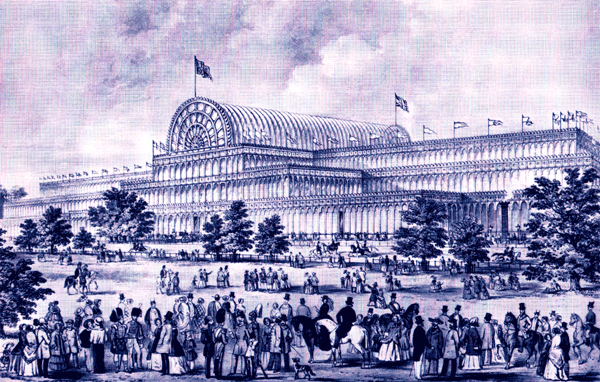
For those of you who don't hail from the UK, The V&A is the Victoria & Albert museum, which was built in 1852, following the huge success of the Great Exhibion for which Crystal Palace was built:


Its founding principle was to make works of art available to all, to educate working people and to inspire British designers and manufacturers. Profits from the Exhibition were used to establish the Museum of Manufactures, as it was initially known, and exhibits were purchased to form the basis of its collections.
The Museum moved to its present site in 1857 and was renamed the South Kensington Museum. Its collections expanded rapidly as it set out to acquire the best examples of metalwork, furniture, textiles and all other forms of decorative art from all periods. It also acquired fine art - paintings, drawings, prints and sculpture - in order to tell a more complete history of art and design.
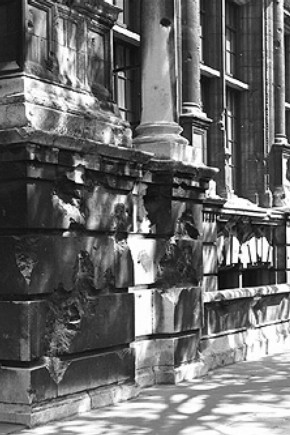
The museum stayed open for the duration of the Second World War, despite being hit and damaged by bombs.Some of the damage to the stonework is still visible today. It was also used as an RAF training college canteen between 1942-45.


This is what it looks like today:

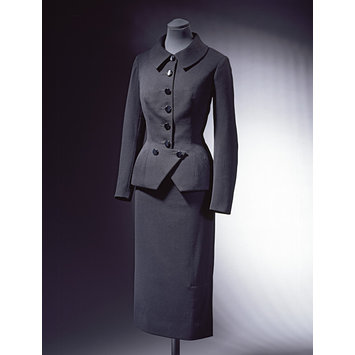
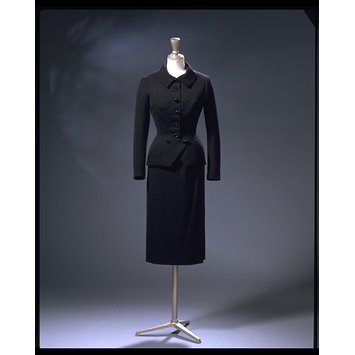
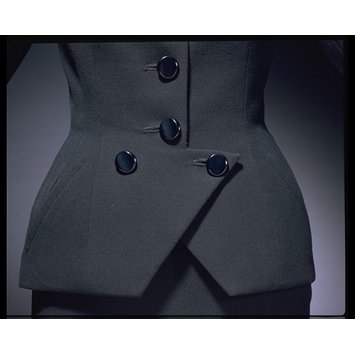
I went to the V&A for a Medieval and Renaissance tour, which was very useful for my Renaissance and Medieval modules at uni. Once the tour had finished, I had a snoop around the rest of it. They have a fantastic fashion exhibition, showing the evolution of fashion from the 18th Century right up until the present day. I spent a good half hour mooning over the '20s '30s and '40s collections. Unfortunately I missed a fantastic exhibition on 50 years of fashion, but will try to make another post about that soon! One of my favourite pieces was this worsted wool skirt suit, by Michael Donéllan from 1954:
Next, it was time to look for the 20th Century section (which took an age to find). They have a great collection of radios there:


Tesla Talisman 308U (1939)
Pye Portable M78F (1948)
An incredibly controversial radio that was
withdrawn from production as the design
resembled the Japanese flag. There are only
around 200 left as 800 of the 1000 produced
were destroyed. 
Murphy A100 (1946)
This radio marked the transition from wartime to peacetime
in industrial production.
Marconiphone P20B (1948)
One of the fist portable designs for radio.
Unfortunately I didn't get a full outfit photograph, but here's one from later on in the day:

Jess xx